
Few organisations can open their archives and hear their very first supporters, more than 100 years on. This Remembrance Day, we have, finding the letters children wrote during World War I.
They were the children of the Silver Chain League, the beginning of today’s Silverchain legacy.
In 1905, Western Mail journalist Muriel Chase, writing as Aunt Mary, invited young readers to become Silver Links, paying a shilling a year to help fund a local district nurse. They wrote to Aunt Mary, who answered them in print. When the First World War came, it filled their letters.
In November 1914, 11-year-old Hector McDonald had written from Wilga, “I wish I was able to go and fight for my country.” Aunt Mary replied that she hoped “by the time you are grown up there will be no more war or rumours of war.”
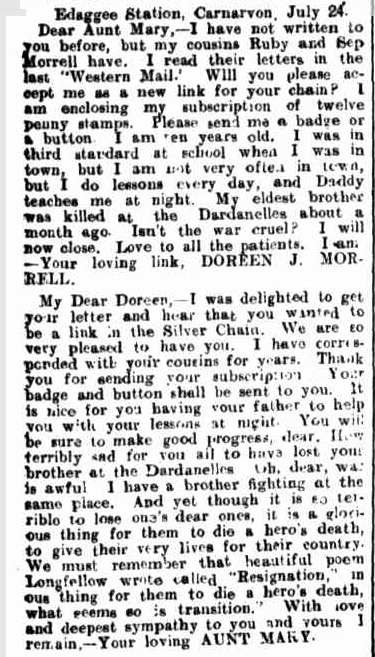
Then came the news of loss. In July 1915, 10-year-old Doreen Morrell of Carnarvon wrote that her eldest brother had been killed at Gallipoli. “Isn’t the war cruel?” she asked. Aunt Mary, who had a brother fighting there too, replied that “war is awful.”
Gladys King of Wagin wrote in 1917 to rejoin, having let her Silverchain membership lapse. Her eldest brother had died of pneumonia and bronchitis, aged 23, and she had 14 cousins in France. Aunt Mary replied: “You know, dear, once a member of the Silver Chain, always a member.”
When peace came, Aunt Mary described Perth’s streets crowded with “the happiest people you could see.” Frank Parker of Dongarra wrote, “Isn’t it lovely to know that the horrible war is over.” Aunt Mary answered that it was “the greatest weight off all our minds.”
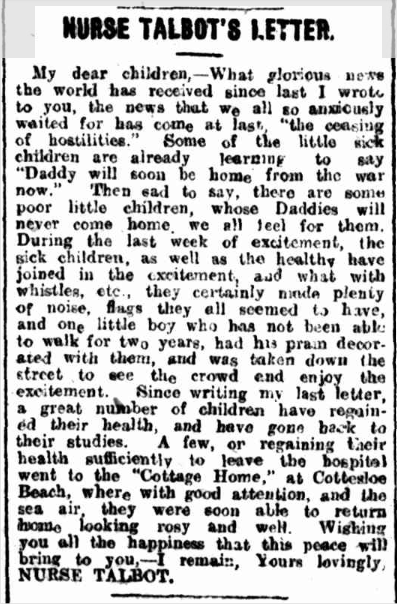
In November 1918, Nurse Talbot, the League’s children’s nurse, wrote about a small boy who had not been able to walk for two years. His pram had been decorated with flags, and he was “taken down the street to see the crowd and enjoy the excitement.” She also wrote that “there are some poor little children, whose Daddies will never come home,” and that “we all feel for them.”
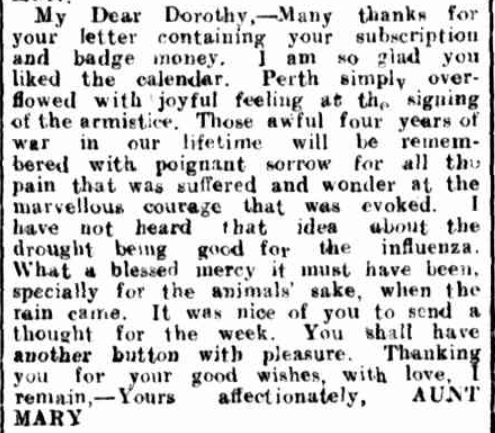
The following year in 1919, Aunt Mary wrote to Dorothy Solomon, a Silver Link in Sydney, “Those awful four years of war in our lifetime will be remembered with poignant sorrow for all the pain that was suffered and wonder at the marvellous courage that was evoked.”
These letters are more than 100 years old, but the feelings in them are not. The worry for a family member far away, the grief and the longing for it all to end have been felt by families at home in every war before and since.
On Remembrance Day, we remember everyone who served, and everyone who waited for them at home.
Lest we forget.


